





The average Japanese commuter spends 348 hours a year getting to work. Here’s why the commute is so long, what life on a packed train actually looks like, and how locals — including me — make it work.
Curious about Japan’s commute culture? Here’s the short version: it’s long, it’s crowded, and almost nobody complains about it.
I was born and raised in Osaka. My daily commute is 90 minutes each way — 3 hours a day, 5 days a week. By Japanese standards, that’s not unusual. According to Japan’s Ministry of Internal Affairs, the national average commute is 1 hour 19 minutes round trip. In Tokyo, it’s 1 hour 35 minutes. In greater Osaka, around 1 hour 26 minutes.
This guide breaks down why Japanese commutes are so long, what the rush hour experience is really like, and what people actually do on the train. Including me — because honestly, I watch anime on Amazon Prime and I’m not ashamed of it.
Japan’s commute culture: why 90 minutes each way is completely normal (and what people do on the train)
1h 19min
Japan’s national average commute time (round trip)
Ministry of Internal Affairs, 2021 Survey on Time Use
1h 35min
Average commute time in Tokyo (round trip)
Ministry of Internal Affairs, 2021 Survey on Time Use
348 hours
Average annual commute time (250 working days)
Based on national average of 1h 19min/day
~15 days
What 348 hours looks like in calendar days
Every year, the average Japanese worker spends two full weeks commuting
For context: the global average commute is about 1 hour 5 minutes round trip. Japan sits above that — and in major metro areas like Tokyo and Osaka, the real numbers are considerably longer than the national average suggests.
| Area | Avg. commute (round trip) | Rush hour congestion rate |
|---|---|---|
| Greater Tokyo | ~1h 42min | 136% (FY2023) |
| Greater Osaka | ~1h 26min | 115% (FY2023) |
| Nagoya area | ~1h 10min | 123% (FY2023) |
| National average | 1h 19min | — |
Congestion rate data: Ministry of Land, Infrastructure, Transport and Tourism, FY2023. A rate of 136% means trains are carrying 36% more passengers than their designed capacity.
Why are Japanese commutes so long?
Three structural reasons explain why commuting in Japan takes so long — and why it’s unlikely to change anytime soon.
1. The cities are enormous.
Greater Tokyo is home to nearly 38 million people. Greater Osaka, around 19 million. When that many people concentrate around a central business district, the gap between “affordable housing” and “close to work” grows fast. Most people can’t afford to live near the office, so they commute from the outskirts.
2. The train system is almost too good.
Japan’s rail network is so reliable, frequent, and comprehensive that long-distance commuting becomes psychologically manageable. A train every 1–2 minutes, door-to-door accuracy within seconds, and seamless transfers across multiple lines — it removes the friction that would otherwise discourage people from living far away.
3. Remote work hasn’t fully taken hold.
Japan’s office culture places significant value on physical presence — being seen at your desk still matters in many workplaces. While COVID accelerated remote work temporarily, many companies have since returned to near-full office attendance.
A local’s honest take
When I tell people outside Japan that I commute 90 minutes each way, the reaction is usually somewhere between sympathy and disbelief. But among my colleagues in Osaka, it barely registers. Several of them commute longer. The question isn’t “isn’t that far?” — it’s “which line do you take?” The distance is assumed. The route is the conversation.
What Tokyo and Osaka rush hour is really like
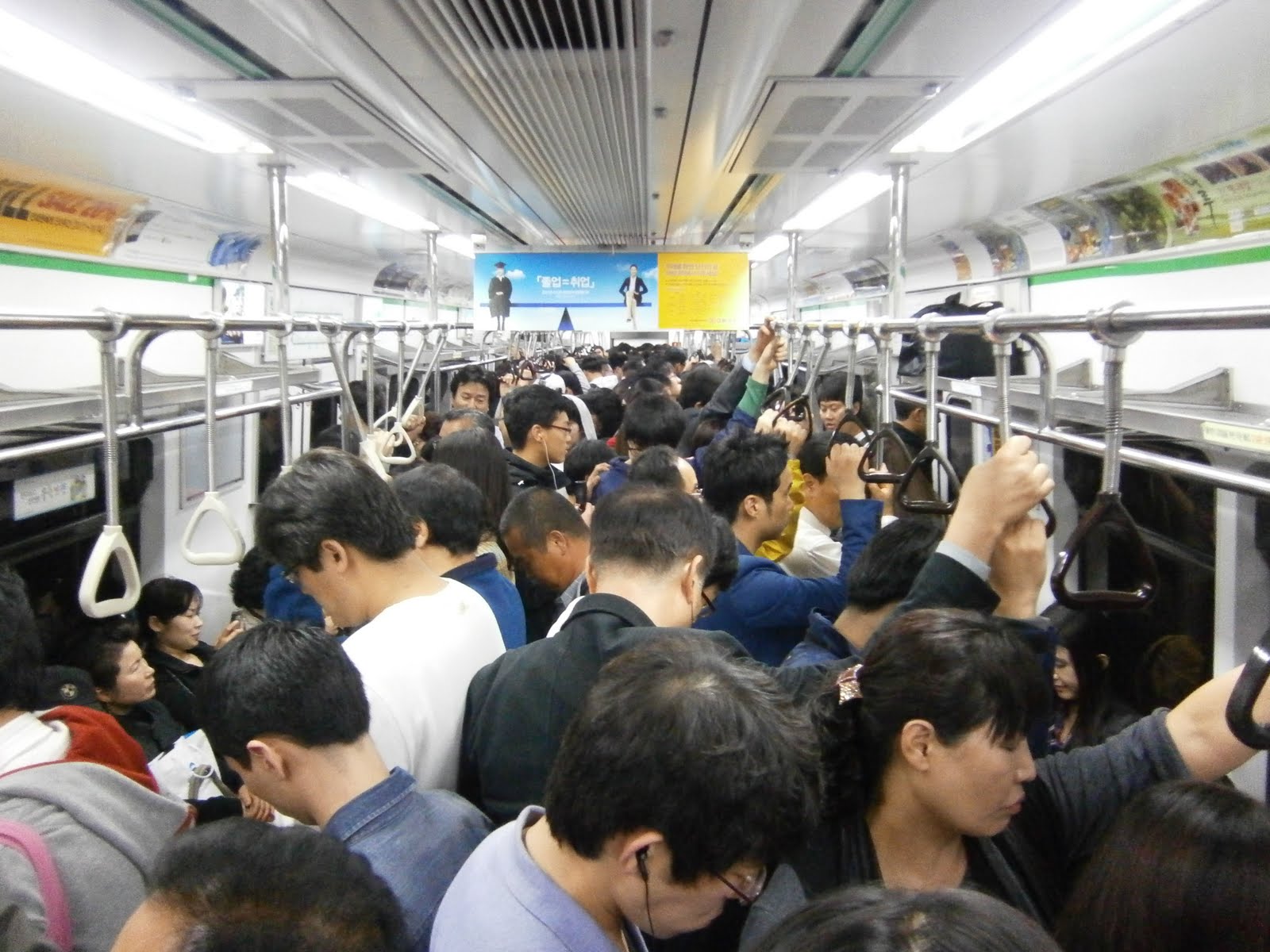
You’ve probably seen the videos — station staff in white gloves pushing passengers into overcrowded train cars. That’s real, but it’s also a specific situation: peak rush hour on the most congested lines in Tokyo.
The everyday reality is more nuanced. Tokyo’s morning rush runs from around 7:30 to 9:30 AM, with the worst congestion between 8:00 and 8:30. Osaka’s rush hour follows a similar pattern, slightly less intense. Outside those windows, trains are crowded but manageable.
What strikes most visitors isn’t the crowding — it’s the silence. Hundreds of people packed into a car, and almost no one is talking. No loud music, no phone calls, no conversations above a murmur. Japanese train etiquette is strict and widely followed: you keep to yourself, you don’t disturb others, and you make the best of whatever space you have.
For visitors: how to handle rush hour
If your schedule allows, shift your travel by 30–60 minutes outside peak times. If you can’t avoid it: step fully inside the car, don’t block the doors, keep your bag in front of you, and follow the flow. Nobody will say anything — just match the energy of the people around you (calm, quiet, inward-facing).
What do Japanese people do on the train?
This is one of the most common questions people ask about Japanese commute culture — and the answer is more interesting than you’d expect.
01 Stare at their phone
Social media, news, videos, mobile games — the overwhelming majority. Look down any train car and you’ll see a wall of screens.
02 Sleep
Japan’s legendary “inemuri” — the ability to fall asleep sitting upright on a moving train and wake up at exactly the right stop. More common than you’d think.
03 Read — books or manga
Physical books are still common. Manga volumes are especially popular. E-readers are gaining ground.
04 Listen to music or podcasts
Almost everyone with earphones is listening to something. Music, podcasts, language learning — earphones are standard commute equipment.
05 Work — emails, documents
Especially common among office workers. Laptops on packed trains are not unusual. The commute is treated as an extension of the workday by many.
What I actually do
I watch anime on Amazon Prime. 90 minutes each way means roughly 3 episodes per trip — 6 episodes a day, 30 a week. I’ve finished entire series I never would have watched otherwise. At some point I stopped dreading the commute and started looking forward to it, because it’s the one part of the day that’s completely mine. No obligations, no interruptions — just me, my earphones, and whatever I’m currently watching. Right now it’s a rewatch of Fullmetal Alchemist: Brotherhood. No regrets.
How to survive (and actually use) a long Japanese commute
The difference between a commute that drains you and one that doesn’t comes down to one thing: treating it as your time, not dead time.
Make one thing “commute-only”
Pick something you only do on the train — a show, a podcast series, a book. When that thing becomes the reward for getting on the train, the commute stops feeling like a cost. I only watch anime during my commute. It sounds small, but it reframes the whole experience.
Download before you board
Subway sections lose signal. Netflix, Amazon Prime, and Spotify all have offline download features — use them. Getting halfway through an episode and losing connection is avoidable and deeply annoying. I download the night before as a habit.
Learn which car and which time gets you a seat
Every regular commuter knows this. The first and last cars are usually less crowded. Shifting departure by 15–20 minutes can be the difference between standing for 90 minutes and sitting. Once you find your pattern, it becomes automatic.
FAQ
- Is the Japanese commute really as bad as the videos make it look?
-
The videos showing station staff pushing passengers into cars are real — but they represent the worst lines at peak times, mostly in central Tokyo. Everyday commuting in Osaka and outside Tokyo’s inner core is crowded but not extreme. The trains run on time, the passengers are quiet and orderly, and it becomes routine surprisingly fast.
- What do Japanese people do on the train to pass the time?
-
Mostly look at their phones — social media, videos, mobile games. Sleeping is extremely common; Japan even has a word for the art of napping upright on a train (inemuri). Reading physical books and manga is still widespread. What you almost never see: phone calls, loud conversations, or eating.
- How does Japan’s commute compare to other countries?
-
The global average commute is around 1 hour 5 minutes round trip. Japan’s national average of 1 hour 19 minutes puts it above average, and in Tokyo and Osaka the real numbers are longer still. The US average is around 48 minutes round trip — roughly half of what Tokyo commuters experience.
- Is remote work common in Japan?
-
Less than in many Western countries. Japan’s workplace culture historically values physical presence, and while COVID pushed remote work adoption forward, many companies have returned to near-full office attendance. IT companies and foreign-affiliated firms tend to be exceptions.
- Should tourists avoid trains during rush hour?
-
If you have flexibility, yes — shifting sightseeing plans by 30–60 minutes outside of 7:30–9:30 AM and 5:00–7:00 PM makes for a more comfortable experience. That said, experiencing rush hour once is genuinely interesting. It’s one of those things about Japan that you have to see to understand.
A 90-minute commute is a long time. But it’s also 90 minutes that nobody can take from you — no meetings, no requests, no obligations. What you do with it is entirely up to you. I chose anime. You might choose something else. Either way, once you find your thing, the train stops being a burden and starts being part of the day you actually look forward to.
More on everyday life in Osaka and Japan







コメント