

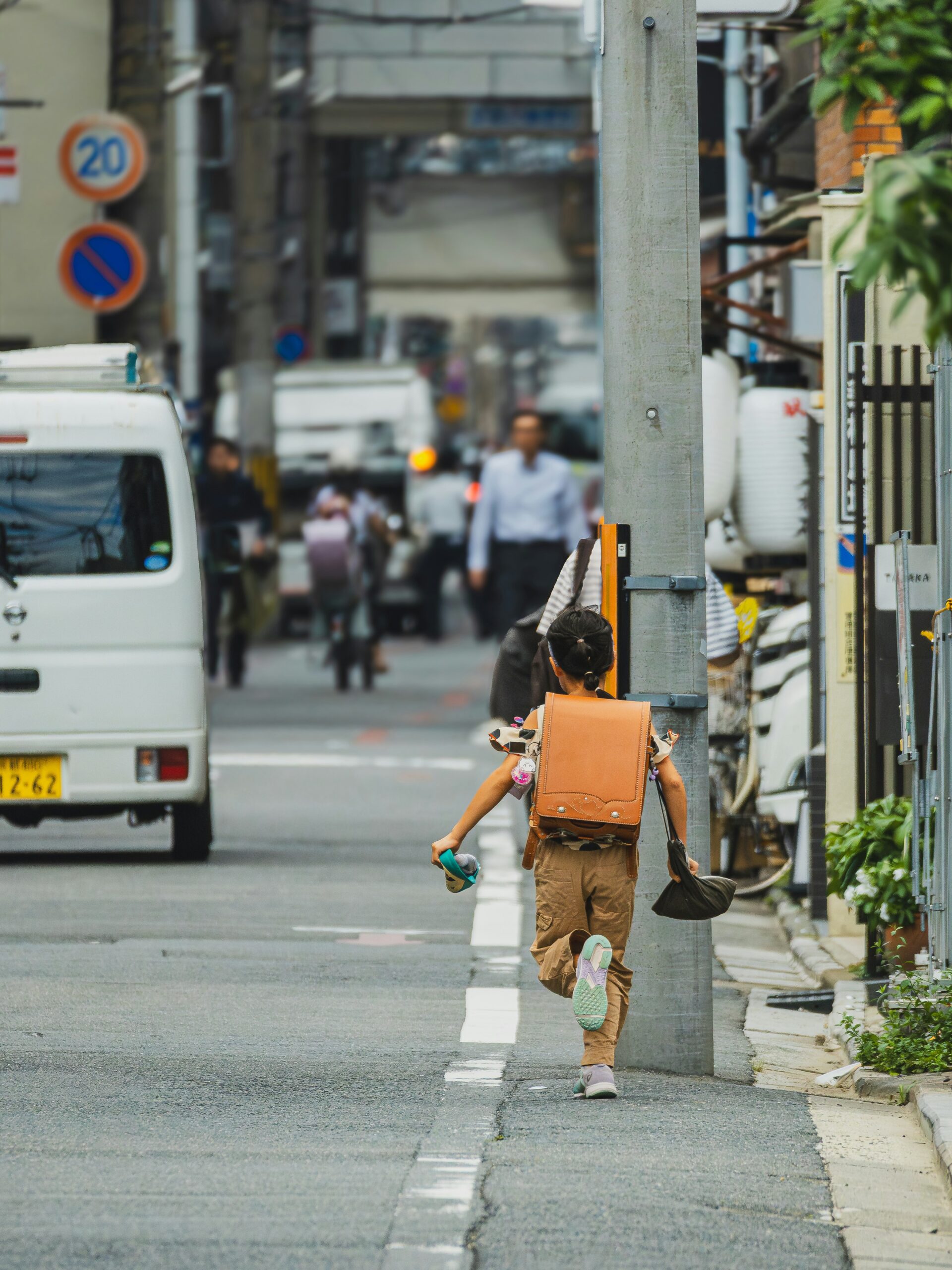




Group walks, neighborhood watch volunteers, low crime rates, and a culture of community trust. Here’s the full picture of why Japan lets 6-year-olds commute independently — and what actually makes it work.
2026 · Written by someone born and raised in Osaka who walked to school alone
Curious about why Japanese children walk to school alone? It’s one of the most common questions people ask about Japan — and one of the most misunderstood.
When I tell people outside Japan that I walked to school alone from age 6, the reaction is always the same: “Wasn’t that dangerous?” “Did your parents worry?” I grew up in Osaka and did it every day, like every other kid in my neighborhood. At the time it felt completely normal. Looking back as a parent now, I understand just how much invisible infrastructure made it possible. This article explains all of it — honestly, with data, and without pretending the risks don’t exist.
The data: how common is independent school travel in Japan?
~80%
Elementary school children who walk to school every day
Chiba city study, 2020 (PMC)
79.2%
Children traveling independently (alone or with peers, no adult)
ScienceDirect study, 2025
66%
Schools with safety patrols staffed entirely by volunteers
Ministry of Education survey, 2016
Under 10%
Schools that employ paid security guards
Ministry of Education survey, 2016
Compared to other developed countries, Japan’s independent school travel rate is exceptionally high. In the US, UK, and Australia, leaving a young child to walk to school alone can be treated as a legal or child welfare issue in some states or regions. In Japan, it has been standard practice since first grade — supported by a layered system of community infrastructure that most outsiders don’t see.
Reason 1: the group walk system (shudan tokou 集団登校)
Most Japanese elementary schools operate a system called shudan tokou — literally “group school commute.” Children from the same neighborhood gather at a fixed meeting point and walk to school together, with older students leading younger ones.
Older students lead younger ones
A sixth grader walking a first grader to school is a common sight in Japan. “Walking alone” often means walking as part of a group where older children are responsible for guiding and watching the younger ones. A 6-year-old starting school isn’t navigating independently from day one — they’re integrated into a structure that already exists.
Fixed routes and times
Because the routes and departure times are set and consistent, the adults in the neighborhood know exactly when and where children will be passing. This predictability is what makes community watch efforts effective — people know where to stand and when.
On my first day of elementary school, I walked to the neighborhood meeting point and a sixth grader was already there waiting. I had no idea where the school was. I just followed. The route took about 15 minutes, and there were familiar adults at certain corners the whole way. I didn’t think of it as “walking alone.” I thought of it as “going with the group.”
Reason 2: neighborhood watch volunteers (mimamori-tai 見守り隊)
During school commute hours, school staff and local volunteers stand at key points along the route — especially at busy crossings — waving flags to guide children safely across roads. These are the mimamori-tai: the neighborhood watch groups that make independent school travel practically viable.
Who does it
Not police officers or paid staff — mostly retired residents, parents, PTA members, and local shopkeepers. The system runs on civic participation. The underlying ethic is that children are the community’s responsibility, not just their parents’.
“Nagara mimamori” — watching while going about your day
As Japan’s population ages and volunteer numbers decline, a newer approach has emerged: “nagara mimamori” (watching while doing something else). Dog walkers, joggers, and people running errands are encouraged to take routes through school zones during commute hours — passive supervision woven into everyday life.
Government backing
Japan’s Ministry of Education publishes a “School Commute Watch Activity Handbook” and provides subsidies for training local safety leaders (School Guard Leaders). In fiscal year 2025, ¥240 million was allocated specifically to support community-based safety infrastructure around schools.
Reason 3: Japan’s low crime rate
Japan is one of the safest countries in the world by most measures. This is a real and significant factor in why independent school travel is possible at the scale it is.
#2
Global Peace Index ranking (2023)
Institute for Economics and Peace
0.2
Homicides per 100,000 people
Japan vs ~6.3 in the US (UNODC)
Research confirms the connection directly: higher perceived safety from crime is positively associated with independent school travel in Japan, and children in areas with community-based supervision are significantly more likely to travel independently.
That said, low crime rate does not mean zero risk. The next section addresses this honestly.
Reason 4: urban design and walking culture
Japan’s public spaces are built with pedestrian movement in mind. The combination of walkability, strong public transport, and small-scale urban environments that control traffic flow creates conditions where children can move through cities more safely than in car-dominated environments.
Schools are close to home
Japan’s school district system places elementary schools within walking distance of the neighborhoods they serve. The assumption is that children will walk — and the urban layout is designed around that assumption.
Drivers yield to pedestrians
Japan has a strong culture of drivers stopping for pedestrians and cyclists. Compliance rates at marked crosswalks are high by international standards, which meaningfully reduces the risk of traffic accidents for children crossing roads.
Reason 5: community trust, not just individual independence
Cultural anthropologist Dwayne Dixon, who has studied Japanese childhood extensively, argues that the reason Japanese children move through public space so confidently isn’t self-reliance — it’s group reliance.
When Japanese parents send their children out alone, there’s an unspoken understanding with the community: that neighbors will watch, that something will be done if something goes wrong, that the street is shared. Children absorb this too. They don’t walk feeling alone — they walk knowing the community is around them.
Kodomo 110-ban no ie (子ども110番の家)
“Children’s 110 houses” are registered households, shops, and facilities across Japan where children can seek help in an emergency. They display a distinctive sticker in the window. Distributed along school routes, they function as a physical safety net — places a child knows they can run to if something feels wrong.
What it actually felt like: a local’s experience
I remember my first day of elementary school clearly. Randoseru backpack on, yellow hat on — the uniform of a Japanese first grader. I walked to the neighborhood gathering point and found older kids already there. The sixth grader said “follow me” and that was it. I just walked behind the group.
The route took about 15 minutes. There were adults at certain corners with orange flags. One of them said “good morning” and I said it back. I didn’t think of any of this as a safety system. I thought it was just how mornings worked.
Now that I have my own children and watch them do the same thing, I see it differently. Those adults with flags, the route itself, the older kids leading — it was all infrastructure. Built by the community, maintained by the community, and mostly invisible to the children it was protecting.
The honest part: risks are not zero
Any article about Japanese children walking to school alone needs to say this clearly: the system works well, but it is not risk-free.
Child crime victimization in Japan runs at an estimated 170,000–340,000 incidents per year across all categories. Traffic accidents involving children have been increasing since the early 2020s, with the highest frequency occurring between 4–6 PM during the afternoon return commute — not the morning walk, which benefits more from the group system and volunteer presence.
Japan’s society continues this practice not because risk has been eliminated, but because it has chosen to manage risk collectively while prioritizing children’s development of independence and community belonging. That’s a cultural value judgment, not a safety guarantee.
Japan vs other countries
Japan
~80% of elementary children walk independently
Group walk system from age 6
Community volunteers at crossings
Legal and socially normal
US / UK / Australia
Independent school travel rates much lower
Can trigger child welfare concerns in some states
School buses common for longer distances
Parent drop-off standard in many areas
Germany and Finland also have relatively high rates of independent school travel among developed nations. But Japan’s combination of very young starting age, high urban density, and the formalized community systems around it makes it distinctive even by European standards.
FAQ
- At what age do Japanese children start walking to school alone?
-
Most children join the group walk system (shudan tokou) from their first year of elementary school, at age 6–7. They walk as part of a group led by older students, so true solo commuting typically comes later — around 3rd or 4th grade for walking, and varies by family for train or bus commutes.
- Why don’t Japanese schools have school buses?
-
Japan’s public elementary school system places schools within walking distance of their catchment areas by design. The assumption is that children will walk, and the urban layout supports this. Walking to school is also considered part of children’s physical education and their introduction to traffic safety and community norms.
- Is it actually safe for children to walk to school alone in Japan?
-
Safer than in many countries, but not without risk. Japan’s low crime rate, well-organized volunteer watch systems, walkable urban design, and group commuting culture combine to make independent school travel viable. Child crime victimization still occurs, and traffic accidents during the afternoon return commute have been rising. The system manages risk — it doesn’t eliminate it.
- What is “shudan tokou”?
-
Shudan tokou (集団登校) means “group school commute.” Children from the same neighborhood walk to school together in a group, organized by residential area, with older students leading younger ones. It’s a standard practice at most Japanese public elementary schools and is the primary reason very young children can commute independently from their first day.
- Do Japanese parents worry about their children walking alone?
-
Yes — Japanese parents worry just like parents anywhere. The difference is that the community infrastructure (volunteer watchers, group walks, registered safe houses) provides enough visible support that parents feel they can rely on the system, not just on themselves. Many families also give children GPS-equipped phones for additional peace of mind.
- How does Japan’s approach compare to other countries?
-
Japan has one of the highest independent school travel rates in the developed world — around 80% walking daily. In the US, UK, and Australia, children walking to school alone, especially at age 6–7, can attract concern from authorities in some areas. Germany and Finland are closer to Japan’s approach, but Japan’s formalized community systems and the young starting age make it distinctive even internationally.
The real answer to “why can Japanese children walk to school alone” isn’t one thing. It’s a low crime rate, a group walk system, a network of community volunteers, urban design built around pedestrians, and a cultural understanding that children belong to the community as much as to their parents. Each element reinforces the others. I walked that 15-minute route to school for six years and never thought about any of it. Looking back, it was one of the most carefully maintained things in my daily life — I just couldn’t see it.
More on Japanese culture and school life





コメント